Ragi (Finger Millet) in India: Nutrition, Cultivation, and Markets
India's most calcium-dense cereal — production geography, nutrition profile, MSP, and the processing economy behind ragi mudde, flour, and malt.
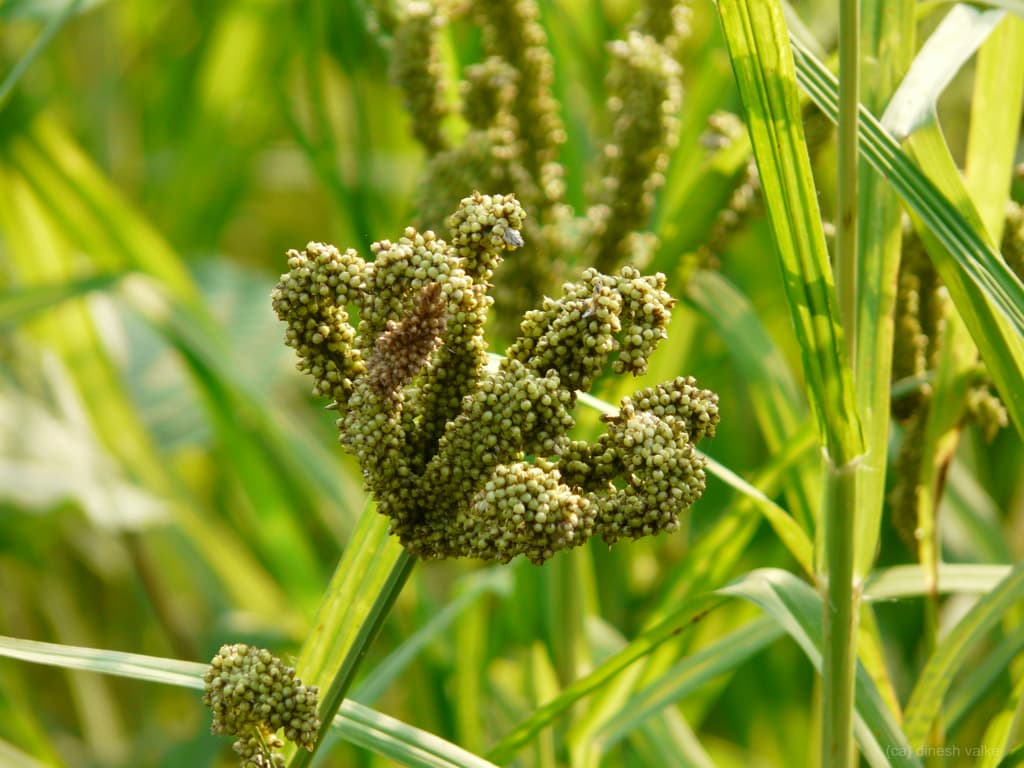
Ragi is India's most calcium-dense cereal and its most widely consumed finger millet — grown across Karnataka, Tamil Nadu, Odisha, and the Himalayan foothills. This page covers what the crop needs to grow, what it delivers on a plate, and where India's ragi economy stands today.
In this article (7 sections)
At a glance
| Metric | Figure | Source |
|---|---|---|
| Botanical name | Eleusine coracana | — |
| India production (2024–25) | 19.77 lakh tonnes | Directorate of Economics & Statistics |
| Top producing state | Karnataka | Directorate of Economics & Statistics |
| MSP (KMS 2025–26) | ₹4,886 per quintal (+₹596 YoY) | PIB / Cabinet |
| Calcium content | 344 mg / 100 g | ICMR Indian Food Composition Tables |
| Crop duration | 3–4.5 months | ICAR-IIMR |
Source: Directorate of Economics & Statistics, Ministry of Agriculture & Farmers Welfare (production, 2024–25); PIB / Cabinet Committee on Economic Affairs (MSP, KMS 2025–26); ICMR Indian Food Composition Tables, 2017 (calcium); ICAR-IIMR (crop duration).
Ragi's MSP increase for the 2025–26 kharif marketing season — ₹596 per quintal — was the largest absolute increase of any crop that year apart from nigerseed, reflecting the government's continued push behind nutri-cereals.
Where ragi is grown
Karnataka is India's largest ragi producer by a wide margin — the crop is deeply embedded in the state's food culture, most visibly as ragi mudde (a steamed ragi ball eaten with sambar or curry), a staple across southern Karnataka's Mandya, Chitradurga, Tumakuru, and Hassan districts. Tamil Nadu and Odisha are the next largest producers, and ragi is also grown at elevation in Uttarakhand's mid-hill districts — a range of growing conditions few other cereals span, from semi-arid plains up to roughly 2,000 metres.
From seed to harvest
Ragi is typically sown with the June–July monsoon as a rainfed kharif crop, often intercropped or rotated with pulses to spread risk across an unpredictable monsoon. As a C4 crop it uses water and sunlight efficiently — part of why it survives on marginal land and in seasons that would fail a rice or wheat crop outright. Harvest follows in three to four and a half months; grain is threshed, dried, and either stored whole or milled into flour, the form in which most urban consumers now encounter it.
Nutrition profile
Ragi's headline number is calcium: 344 mg per 100 g, the highest of any commonly consumed cereal and several multiples of rice or wheat, according to the ICMR's Indian Food Composition Tables. It also carries roughly 7.3 g of protein and 3.9 mg of iron per 100 g, meaningful dietary fibre (around 11.2 g/100 g), and a moderate glycaemic index (approximately 54) relative to polished rice. It is naturally gluten-free, which has driven a second wave of urban demand well beyond ragi's traditional growing regions. Fermentation — as in traditional ragi malt drinks (ragi java) or dosa/idli batter — reduces phytic acid and improves how much of that calcium and iron the body can actually absorb.
Processing and products
Ragi enters commercial supply chains mainly as whole grain, milled flour, and malted flour. Malting — partially germinating the grain before drying and grinding — is common for infant-food and health-drink applications, building on ragi's long-standing traditional use as a first weaning food in parts of South India. Processing units range from small stone mills serving a single district to larger roller-mill lines producing branded flour and malt products for national retail.
Government support
Ragi processing is one of the crops explicitly supported under India's Shree Anna Mission, and eligible units can draw on both the PLISMBP incentive scheme and PMFME support for setting up or upgrading processing capacity. See the schemes tracker for eligibility and current deadlines.
Frequently asked questions
Is ragi the same as finger millet?
Yes — ragi is the Hindi/Kannada name for finger millet (Eleusine coracana).
Which Indian state produces the most ragi?
Karnataka is India's largest ragi-producing state, followed by Tamil Nadu and Odisha.
What is the MSP for ragi in 2025–26?
₹4,886 per quintal, an increase of ₹596 over the prior kharif marketing season — the second-largest absolute MSP increase of any crop that year.
Is ragi gluten-free?
Yes. Ragi is naturally gluten-free, making it suitable for people with celiac disease or gluten sensitivity.
How much calcium does ragi contain?
Approximately 344 mg per 100 g of raw grain — the highest of any commonly consumed cereal, and roughly three times the calcium in full-fat milk by weight.
References (4 sources)
- Directorate of Economics and Statistics, Ministry of Agriculture & Farmers Welfare — Ragi production and state-level distribution, 2024–25.
- PIB / Cabinet Committee on Economic Affairs — MSP announcement for ragi, Kharif Marketing Season 2025–26.
- ICMR Indian Food Composition Tables, 2017 — Calcium, protein, iron, and fibre content per 100g.
- ICAR-Indian Institute of Millets Research — Agronomy and crop-duration context.
Continue reading
Crop reference
Bajra — India's largest millet
Production geography, MSP, varieties, and the value-added economy.
Crop reference
Jowar — India's second-largest millet
Production, MSP, and processing for sorghum in India.
Scheme tracker
Shree Anna Mission
₹600 cr Union Budget allocation for millet promotion, including ragi processing support.